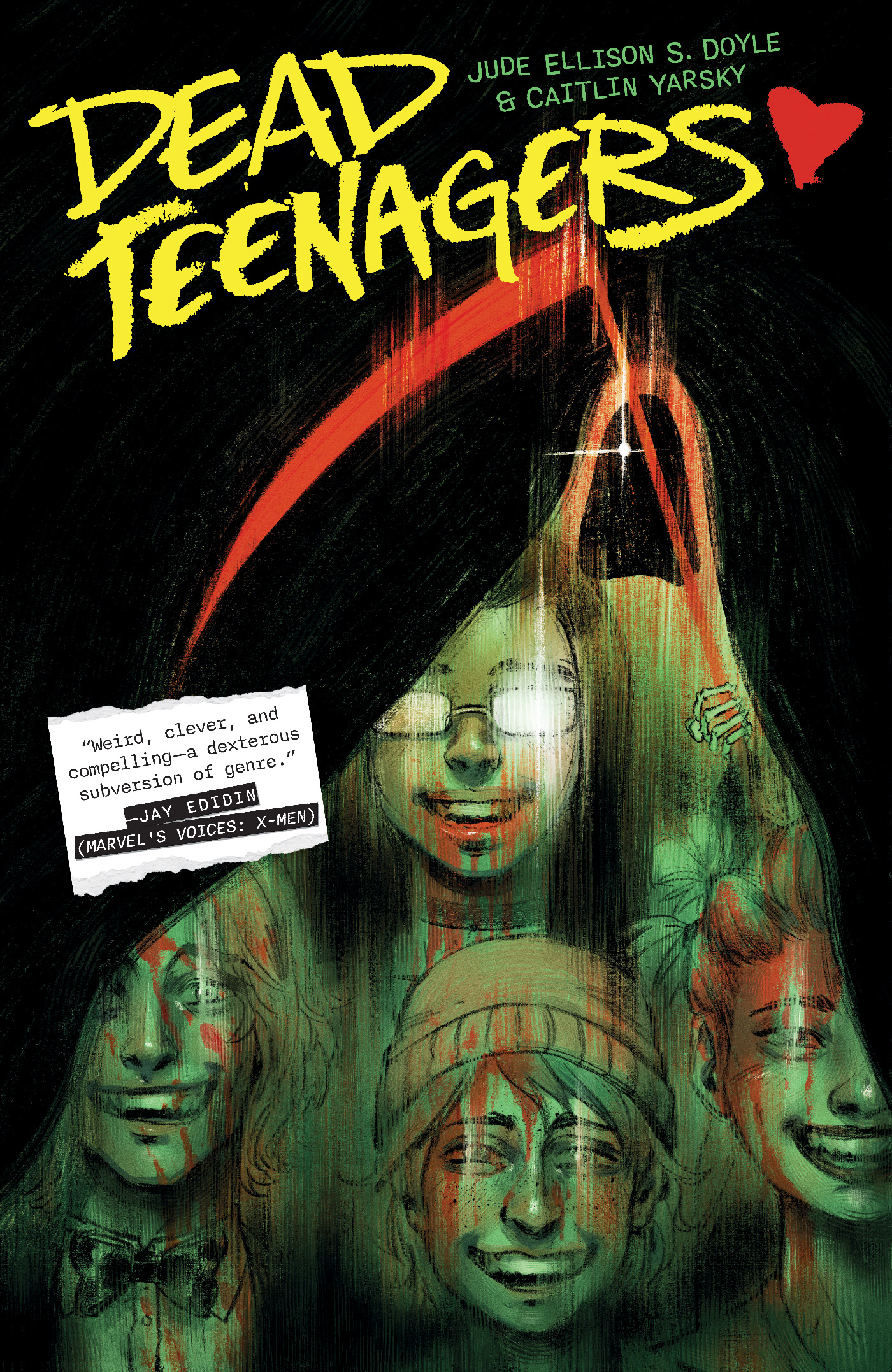
One reason that the horror genre has stood the test of time is that so many of those stories acknowledge adolescence and coming of age is just as scary as any gremlin or specter or masked killer. The best of those tales pair the terror of being a teen and the fear of phantoms and poltergeists as mirrors of one another. That’s a truth that writer Jude Ellison S. Doyle and artist Caitlin Yarsky show they know well in their comic miniseries Dead Teenagers, now on sale in trade paperback from Oni Press.
From the creative team of writer Jude Ellison S. Doyle and artist Caitlin Yarsky, Dead Teenagers follows five teens who must relive their prom night on loop, over and over again, dying horrifically each time. When the loop is undone, they find themselves in the 2020s, middle-aged, and still at risk for more death committed against them. I spoke with Jude Ellison S. Doyle and Caitlin Yarksky about the idea behind Dead Teenagers, their collaboration together, the predicament the eponymous protagonists find themselves in, and what accounts for the longevity of horror’s popularity.
Jude Ellison S. Doyle is a master of taking horror and approaching it in a way that leaves you drawn in and unnerved at the same time; check out their BOOM! Studios Be Not Afraid series for that unease that infects your core. And I’ve loved Caitlin Yarsky’s skill in building goosebump-inducing atmosphere as far back as her work on Image Comics’ Coyotes. Their understanding of the genre and getting the mercurial mix of horror and teen angst just right is on full display in Dead Teenagers and is the perfect treat for readers this spooky season and beyond.
FreakSugar: Before we get into the book itself, what was the genesis of the comic?
Jude Ellison S. Doyle: It really sprang out of my obsession with campy old B-movies about monsters killing teenagers. There are a thousand of them, and the monsters are so silly and creative: Class of 1999, where it’s robot teachers killing their students; Tourist Trap, where it’s haunted mannequins turning teenagers into mannequins; Brainscan, where kids are being killed by a haunted CD-ROM game from the early ‘90s, which is great, because you have to keep changing out the disks so that it can keep haunting and/or killing you. I love those movies, because they’re made for nothing, and nobody involved thinks they’re making a masterpiece, and yet they’re colorful and creative and full of life in a way so many “better” movies aren’t.
I had just written a limited series called Be Not Afraid, which was probably the darkest and grimmest script I’d ever written, and I was really proud of it, but I couldn’t do another one like it. I really wanted to dive into the opposite extreme of what horror can be. That meant pitting monsters against teenagers in ridiculous scenarios, and trying to come up with a way to include as many of those monsters as possible. Which is where time loops came in.
FS: For folks unfamiliar with Dead Teenagers, what is the conceit of the series?
JESD: Now that the whole series is out, I can tell you that it’s about five teenagers who have been reliving Prom Night, 1997, over and over on a loop for about thirty years. Every night, they go to the prom, and every night, they die in a new way. At some point, though, the loop breaks down, and they’re catapulted into the “future,” which is our present: They have to be middle-aged adults in the 2020s, which I feel is the ultimate horror. Also, something is still hunting them.
FS: What can you tell us about our doomed teens?
JESD: I can tell you that all of them are stranded in an adulthood they’re not prepared for, and that was, in some sense, never supposed to happen. Some of them are successes, some of them are failures; some of them are cooler, and some of them are way less cool; some of them have changed, in adulthood, and some of them have stayed the same. But all of them are seeing the choices they made as kids play out, and deciding if they actually like the people they’re becoming.
FS: I was a teenager in the 1990s and the atmosphere and look feel so authentic. And the horror is chilling. What was the collaboration like on the book?
JESD: It was great for me! Caitlin is a fantastic collaborator, and obviously a huge star, and she can draw absolutely fucking anything, which is great, because I threw everything at her. I’ve always wanted a giant lizard in one of my books, and the giant lizard she gave me is my favorite guy ever. I want a plushie of him. I want him on T-shirts. He needs to become a cultural icon, I think. It was probably a really nerve-wracking experience for everyone else, though, because I was so nervous that I wouldn’t stop editing the script.
Caitlin Yarsky: I had a blast, it was really fun and nostalgic revisiting the 90’s aesthetic. And it was a new kind of challenge to tackle all the chaotic scenarios of the time loop. Jude’s story is also full of quieter poignant scenes, which are more my wheelhouse and allowed me to connect with the characters.


FS: I think we all have our unique experiences with high school. They play a part–small or large–in shaping who we are, for good or ill. Did you pull from any personal experiences for the comic?
JESD: Well, one of the characters is trans, as am I, so her experience of just not showing up in any of her own memories of high school is very close to my own. The way I dealt with it in the book was to have her literally just be off-panel in all of her flashbacks. Which is kind of what it feels like, when all of your memories feature a person who isn’t you. I also really related to Ryder, trying very hard to be cool throughout his adolescence, and waking up one day to find out he’s just somebody’s boring Dad.
CY: I was part of a weird artsy fringe friend group in high school, so this particular gang seems cooler than I ever was. But I think that, while the situations are totally insane, that heightened drama IS what it feels like to be a teenager. Every conflict, interaction or obstacle feels like the End Of The World.
FS: Do you have any favorite teen horror romps that you revisit and/or influenced this story?
JESD: Oh, God, I have a million of them. I will talk your ear off about this, if you let me. But if you want an all-time great, campy, so bad-it’s-amazing movie, Jason X – the one where Jason goes to space, and finds himself on a spaceship that’s somehow operated entirely by horny teenagers – is maybe my absolute favorite. I also think the first Final Destination is endlessly clever and creative and understands, as all good teen horror movies do, that on some level a slasher is just a very bloody slapstick comedy. And if you want my favorite slasher comic, Maniac of New York always impresses me. It’s made with a sense of horror and a sense of fun and knows exactly where and when to deploy each one.
CY: My favorite show growing up was Buffy the Vampire Slayer, so the humor/horror combo of Dead Teenagers definitely felt familiar and accessible. And Goosebumps was a series that got me into reading as a kid; that absurdist, campy tone definitely came in handy.
FS: Why do you think the teen horror genre is infinitely revisitable without ever being exhausted?
JESD: I think Jane Schoenbrun got it right: It’s “teenage sex and death,” experiencing the extremes of life at an age when everything feels even more extreme. Adolescence is such a high-stakes time, and everyone has to go through it alone and for the first time, racking up formative traumas. Sex is new, and scary. Independence is new, and scary. The violence of the world, frankly, is very scary – I don’t think you can forget the fact that the traditional slasher, like Black Christmas, is mostly young women or girls trying to survive sexualized violence that is very much a part of the real world. We all carry around our teen selves, and their fears, even when we age out of that demographic. So for teenagers, teen horror is a way to explore the world and play around with the types of horrors they would have been shielded from as children, and for adults, it’s a way to go back and re-examine those years and how scary they were.
FS: This book seems like it was a lot of fun to work on. What was your favorite part of the process?
JESD: My favorite part was the part when it was published, because it meant I couldn’t rewrite the dialogue any more. Although you never know. Maybe I’ll just sneak into bookstores and scribble on the books.
CY: I always enjoy the intimate dramatic scenes between characters (ironically not everyone’s favorite stuff to draw- many call them “talking head” scenes). But character acting is my favorite part of drawing comics. I think it’s hard to care about the action aspects of a story without emotionally connecting to a character, so those scenes are important to nail down.
FS: What are you reading right now?
JESD: I just got into Tillie Walden – better late than never – and Are You Listening? is, I think, a tremendous graphic novel. Walden has such a dreamlike, emotive way of putting a page together; it wavers in and out of reality in ways that communicate so much more than pure realism would do. I just reread the first run of Runaways, which I loved way back when it was first published – Brian K. Vaughan is so good at teen group dynamics, and that really influenced how Dead Teenagers was written. I also just read Anthony Oliveira’s Dayspring, and I’m still thinking about it; Oliveira writes for Marvel, but this is a long poem-as-novel, like an Anne Carson thing. It should be impossible for anyone who’s not Anne Carson to pull that off, but the book hit me like a freight train. It was great.
CY: Currently reading Bendis’ Jessica Jones, and A Ghost Arm Made of Angry Ghosts by Oliver Mertz and Alex Diotto. Both fantastic in totally different ways! I’ve also just started a book called Mary by Nat Cassidy.
FS: If you had a final pitch for Dead Teenagers, what would it be?
JESD: It has a really, really great giant lizard. Also, a medium-sized lizard, who is pretty good.
The Dead Teenagers trade paperback collecting issues #1-5 is on sale now from Oni Press.
From the official trade paperback description:
FOR FIVE FRIENDS, THE HORRORS OF HIGH SCHOOL LITERALLY NEVER END!
Since 1997, five friends have been trapped in the ultimate nightmare as a mysterious entity forces them to relive their first prom night over and over again . . . and re-kills them in new and increasingly insane ways each time. They dress up. They party. They make out. And no matter what they try to change, they always die . . . until now. Something is about to break the cycle that has kept Alicia, J.T., Ryder, Brandy, and their group of friends locked in a bizarre purgatory beyond all understanding . . . but what they find on the other side will be the most disturbing revelation of all.
Hell is the ’90s in this brash and brutal, genre-distorting ode to the generation that gave us Scream and Buffy the Vampire Slayer—and what’s become of them since—as GLAAD Award–nominated writer Jude Ellison S. Doyle (Maw, Be Not Afraid) and hyper-talented artist Caitlin Yarsky (Black Hammer Reborn, EC’s Cruel Universe) unleash the year’s most clever and compulsively page-turning horror thriller.