

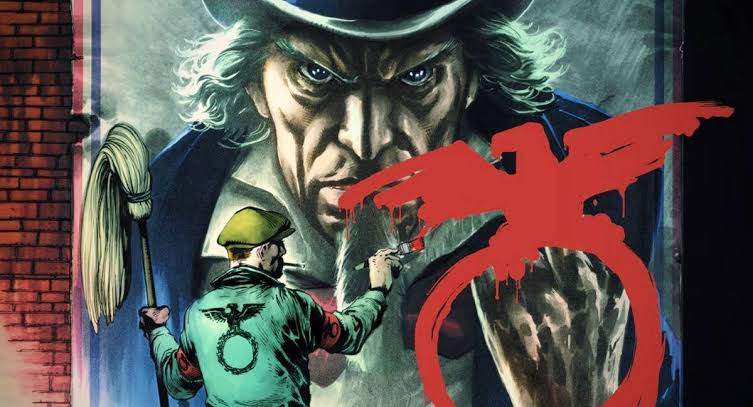
Back in 2018, DC Comics hired the wonderful writer Robert Venditti to helm a new Freedom Fighters 12-issue maxiseries. In the comic, Venditti focused a lens on a United States under the thumb of Adolf Hitler’s son. A new generation of Freedom Fighters must rise to the task to stop this Fuhrer’s reign and bring back Uncle Sam, the embodiment of the American spirit. It’s a comic that was much needed at that time in 2018–and well worth revisiting today.
In 2019, I spoke with Robert Venditti about the series, the state of the world in his comic, and how we always need heroes to look to rise to the challenge of protecting our freedoms.
Editor’s note: Due to technical difficulties, this interview was never published. Those difficulties have been rectified and the interview is being published here now, edited with considerations of the time that has passed between the interview and today.

FreakSugar: I’m really liking this iteration of the Freedom Fighters. For readers who might not be as familiar, can you tell us who the Freedom Fighters are?
Robert Venditti: There’s two answers to that question. So when we start off our series, we’re dealing with new versions of the characters. It’s set in the 1960s, and they’re led by Jesse Owens, the famous American athlete from the 1936 Olympics. And after that scene, we move forward to the present, where it’s now the modern day.
It’s 55 years later, and there’s a new generation of Freedom Fighters. America has been under Nazi control for 55 years. Hitler’s son is now the Fuhrer. And this new generation of Freedom Fighters rises up, taking on the mantle of the previous generation. So it’s a new version of Black Condor, a new version of It’s Not Doll Man, It’s Doll Woman, a new version of The Human Bomb, and a new version of Phantom Lady. And they are trying to restoke the American spirit,
make everyone remember what they’ve forgotten, because America hasn’t seen heroes in 55 years, with the ultimate goal of bringing back Uncle Sam, whose strength is tied to the strength of the American nation. And so if they can get back Uncle Sam, who’s a massively powerful character, then this revolution can begin in earnest, and they can free not just America, but the world from the Nazi regime.
FS: Like you said, we see a new team in the book. I was wondering, can you tell us about their dynamic and how it contrasts with the dynamic of the team from the 1960s and 1970s?
RV: This is a team of young individuals that has never grown up in a world that was free. You know, and so they’re fighting for freedom almost in the abstract. It’s not something that they had and they lost like the original Freedom Fighters did. This group has never
had it. But there can almost be more hope there, you know, what’s possible and what isn’t possible. You know, that’s the great thing about youth. Anything is possible because you don’t know what is impossible. You know, you haven’t lived enough life to sort of have that taken out of you yet.
And so they all come to the Freedom Fighters for different reasons. They will see throughout the series they’re all motivated by different things, but their goal is all the same, which is to bring back Uncle Sam and, you know, shake off the yoke of the Hitler regime. And in doing so some of them are in it for payback. Some are in it because they have regrets that they’re trying to work off. There’s different reasons for each of the characters to be there, but they all have the same mission.
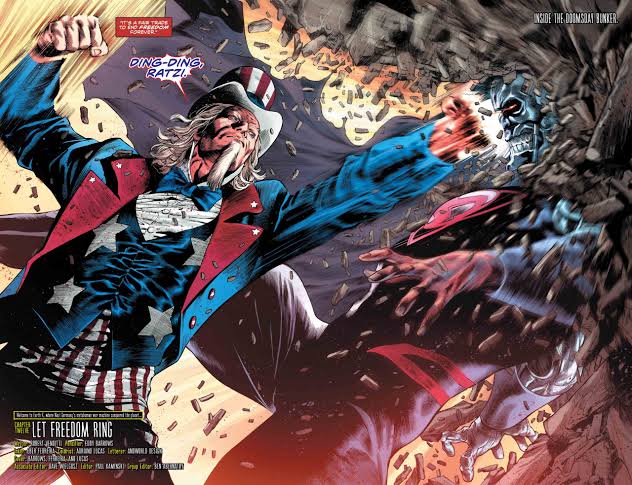
FS: The world and the products and the comics are a lot different than what we experienced. But we have seen an uncomfortable rise in white nationalists and folks with Nazi ideals–or they’re at least more outspoken and already held those beliefs. Does any of that come into play whenever you’re writing?
RV: Yeah, I came to the series at a different angle. At the time DC approached me about writing Freedom Fighters, I was working on a book called Six Days. It’s a nonfiction graphic novel about a battle my uncle was involved in in World War II as part of the D-Day invasion. He was killed in that battle. And so I was already in sort of that headspace of examining the sacrifices of soldiers and civilians of that generation and the world that we were allowed to have because of them. And so this was an opportunity to sort of look at similar content from a different angle.
If those sacrifices hadn’t been made, if they hadn’t been enough, what would this world be like?
And that was where I entered into it. But for me, I think the ultimate, I guess, theme of the story is that no matter how dark the times, I’m a very hopeful person by nature and no matter how dark the time, there will always be heroes that present themselves. And sometimes the darker the times, the brighter the heroes, you know, and that’s really what the story is about. It’s about finding hope and finding light. And, you know, I think that’s a theme that is always relevant.